


Picture this. It’s September 2023. Prime Minister Justin Trudeau stands in Parliament and accuses India of orchestrating a political assassination on Canadian soil. India fires back, calling the claims “absurd.” Diplomats are expelled. Visas are frozen. The relationship between Ottawa and New Delhi isn’t just cold—it’s arctic.
Now flash forward to Feburary 2026. Canada’s new Prime Minister, Mark Carney, is in Goa, India, shaking hands with Indian energy ministers. They’re not talking about apologies or investigations. They’re talking about billions of dollars in oil, natural gas, and uranium. They’re planning one of the largest energy partnerships in Canadian history.
What happened? Money talked, and grievances walked.
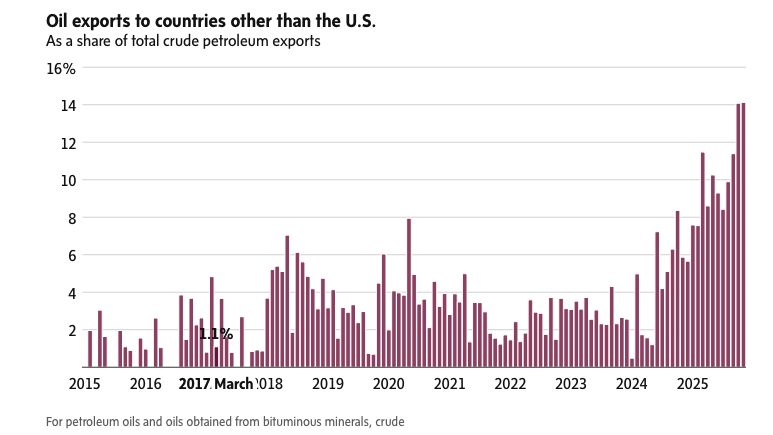
Canada has been making a massive strategic mistake for decades. The country is the world’s fourth-largest oil producer and fifth-largest natural gas producer, an energy superpower. But the catch is that Canada has been selling almost everything to just one customer. Between 97 and 98 cents of every dollar we make from energy exports goes to the United States.
Imagine if you owned a successful bakery, but you only sold to one café down the street. What happens when that café decides to bake its own bread? Or when they tell you they’ll only pay half-price because they know you have nowhere else to go? That’s been Canada’s energy story so far.
This single-customer dependency has cost us billions. Canadian oil, called Western Canada Select, has historically sold at a discount of $15 to $20 per barrel compared to American oil, simply because the country had no other buyers. It’s like being forced to sell your house for $600,000 because there’s only one person willing to buy it, even though it should be worth $800,000 on paper.
Canadian officials now openly call this a “strategic blunder.” And they’re right.
While Canada was stuck in its one-customer trap, India was experiencing an energy crisis of a different kind.
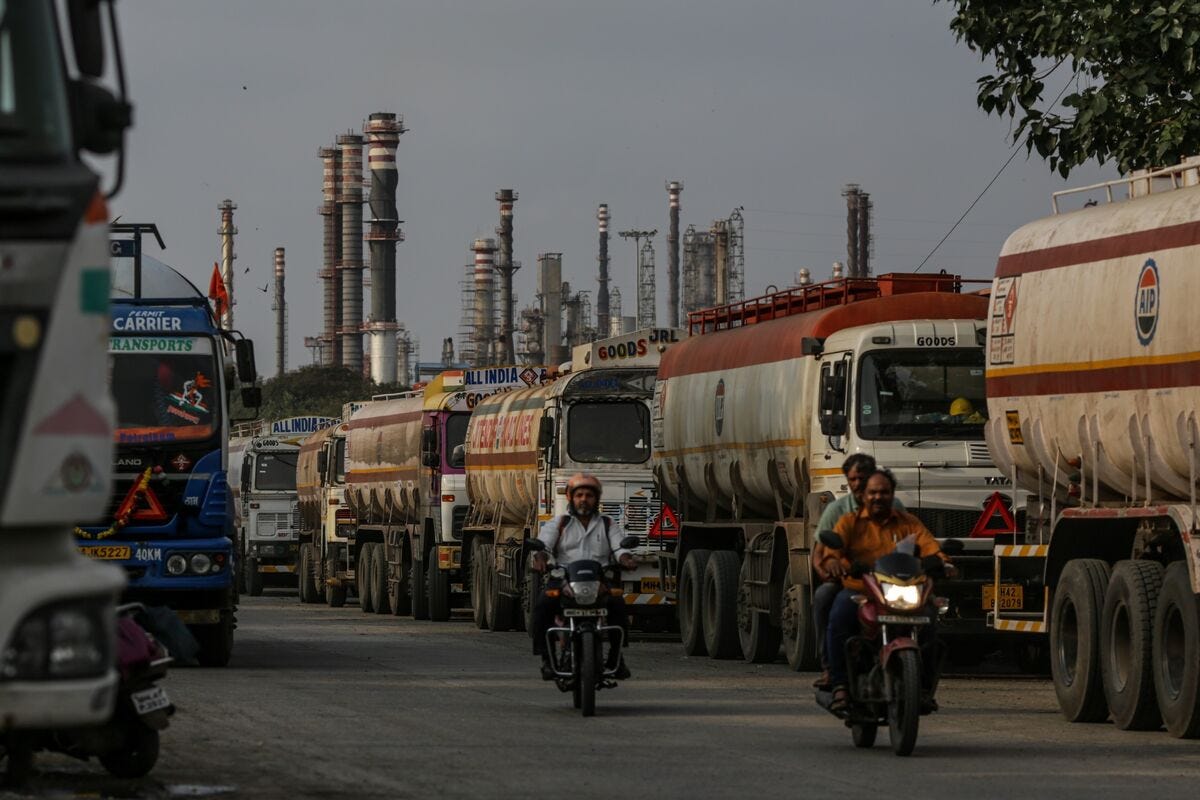
India is now the world’s third-largest oil consumer and fourth-largest natural gas importer. By 2040, India will drive more than one-third of all new energy demand globally. But India has its own problem. It imports 88% of its crude oil and is dependent on Middle Eastern suppliers and, increasingly, on discounted Russian oil (which made up 37% of its imports in 2023-24). With sanctions tightening and global politics shifting, India needs reliable partners who won’t use energy as a political weapon.
Canada and India need each other.
For years, this was just talk. Canada’s oil and gas were locked in the prairies and northern regions, with no way to reach Asian markets. Then, two massive projects came online that changed the game entirely.
In May 2024, the Trans Mountain Expansion pipeline was completed. This $30-billion mega-project nearly tripled capacity, allowing 890,000 barrels of oil per day to flow from Alberta to Canada’s West Coast. Suddenly, oil tankers could leave Vancouver and reach Asian ports in days, not weeks.
Then in June 2025, the LNG Canada facility in Kitimat, British Columbia. the largest private investment in Canadian history at $40 billion, began producing liquefied natural gas for export. Picture a facility so massive it can cool natural gas to -160°C, compress it into liquid form, and load it onto ships bound for India, China, Japan, and South Korea.
These aren’t just pipelines and plants. They’re Canada’s gateway to economic independence.
So what exactly are Canada and India negotiating?
The framework is stunning in its ambition. By the end of 2027, Canada aims to ship 100,000 barrels of oil per day to India, roughly what all of British Columbia consumes in a week. By 2032, Canada is targeting 2 to 3 million tonnes of LNG annually, sufficient to heat every home in Ontario for an entire winter. There’s also a $2.8 billion uranium deal on the table, enough to power 25% of India’s expanding nuclear reactors for the next decade.
India, with the world’s fourth-largest refining capacity, will also process Canadian crude and send refined petroleum products back to us. It’s a circular trade relationship—Canada sends them the raw ingredients, they send us the finished product.
As a result of this circular trade relationship, Indian state-owned energy giants are also eyeing direct investments in Canadian gas fields and LNG facilities. They want ownership stakes, not just supply contracts. For Canada, this means billions in foreign investment. For India, it means guaranteed access to energy, no matter what happens in global markets.
The numbers are staggering. By 2030, total bilateral energy trade could exceed $15 billion annually—that’s roughly what Canadians spend on coffee and restaurants combined in a year. Infrastructure investments could surpass $50 billion, enough to give every Canadian household a $1,300 cheque. And Canada’s ambition also includes shifting 15 to 25% of our energy exports away from the U.S. by the end of the decade.
Let’s bring this home. What does this actually mean for everyday Canadians?
First, jobs. The mature LNG industry alone is projected to support nearly 97,000 jobs across Canada, with over 71,000 in British Columbia. These aren’t minimum-wage positions. The industry is expected to generate more than $6 billion in annual wages.
Second, government revenue. LNG exports could deliver over $2 billion per year in taxes and royalties, with British Columbia projected to collect $90 billion in revenue by 2064. That’s money for schools, hospitals, and infrastructure.
Third, the price discount problem gets fixed. Already, the gap between Canadian and American oil prices has narrowed to under $10 per barrel, the tightest it’s been in years. Accessing Asian markets means Canadian producers can finally charge what their oil is actually worth. Even a $5-per-barrel improvement translates into roughly $9 billion in additional annual revenue for the sector.
Of course, not everyone is celebrating.
Environmental critics point out that expanding oil and gas production runs counter to Canada’s climate commitments. Yes, Canadian LNG might help India shut down coal plants, and Canadian facilities are designed to produce 35 to 60% fewer emissions than global competitors, but we’re still talking about fossil fuels.
Some Indigenous groups, particularly those represented by the Union of B.C. Indian Chiefs, have raised concerns about fracking, water contamination, and the federal government’s decision to fast-track projects without full consultation. The tension is real. While some Nations are enthusiastic project partners and owners, others see this as environmental destruction dressed up as “nation-building.”
There’s also the global market reality. LNG prices are volatile. India is price-sensitive. If costs spike, Indian buyers have historically switched back to coal or cheaper alternatives. And with the U.S. and Qatar ramping up production in the late 2020s, there’s a risk of oversupply driving prices, and profits, down.
But geopolitics doesn’t wait for perfect conditions.
The world is fragmenting. Energy is being weaponized. Supply chains are being redrawn. Countries are choosing sides. In this environment, Canada’s decision to diversify away from total U.S. dependence isn’t just smart economics, it’s national security.
And the India relationship, despite its rocky diplomatic start, offers mutual need. India needs stable, non-sanctioned energy. Canada needs customers who will pay fair prices. It’s not a relationship built on shared values or historical friendship. It’s built on durable aligned interests.
Prime Minister Carney’s approach has been ruthlessly pragmatic. Forget the diplomatic drama. Focus on the deal. It’s a cold calculus, but in the current global order, it might be the right one.
This isn’t about abandoning the U.S. market. It’s about having options. It’s about Canadian oil fetching global prices. It’s about our natural gas powering Mumbai instead of sitting stranded in Alberta. It’s about transforming a “strategic blunder” into a strategic advantage.
From frozen relations to flowing oil, Canada and India are writing a new chapter—one where yesterday’s enemies become tomorrow’s indispensable partners. And in a world where economics increasingly trumps ideology, that might be the most unexpected plot twist of all.