


What is the fate of a middle power? Think of it like a high school lunch period, where there are a few kids who naturally gravitate to the center of the cafeteria, and everyone else figures out where they fit around them. It is not necessarily about dominance—more about gravitational pull.
Prior to this year’s World Economic Forum (WEF) in Davos, Switzerland, the conventional wisdom was depressingly simple: middle powers must accommodate the interests of great powers. It is not a particularly inspiring rallying cry, but it has been the operating manual for most of human history.
The clearest and most tragic example is the ongoing war in Ukraine, a nation that by every metric qualifies as a middle power. Before February 2022, Ukraine produced approximately 10% of the world’s wheat exports, ranked as the world’s 13th largest steel producer, and boasted a GDP of $200 billion with 44 million citizens. That prosperity, however, came with invisible strings attached to Moscow. When President Zelensky tilted toward European integration, essentially trying to switch lunch tables, Putin responded with a full-scale invasion.
If not for Russia’s shocking military incompetence and $113 billion in U.S. aid through 2024, this war would have concluded long ago. Instead, the conflict has dragged on for nearly four years, with the UN estimating over 500,000 combined military casualties and millions displaced. It is the grim reality that we scroll past while checking our phones.
But isolating Russia would be unfair given recent developments in Venezuela. In January 2025, the Trump administration facilitated the capture of Nicolás Maduro, who maintained close ties with both China (Venezuela’s largest creditor) and Russia. While this does not constitute the full-scale invasion evident in Ukraine, the message rings clear that middle powers enjoy freedom only as long as they accommodate the nearest great power.
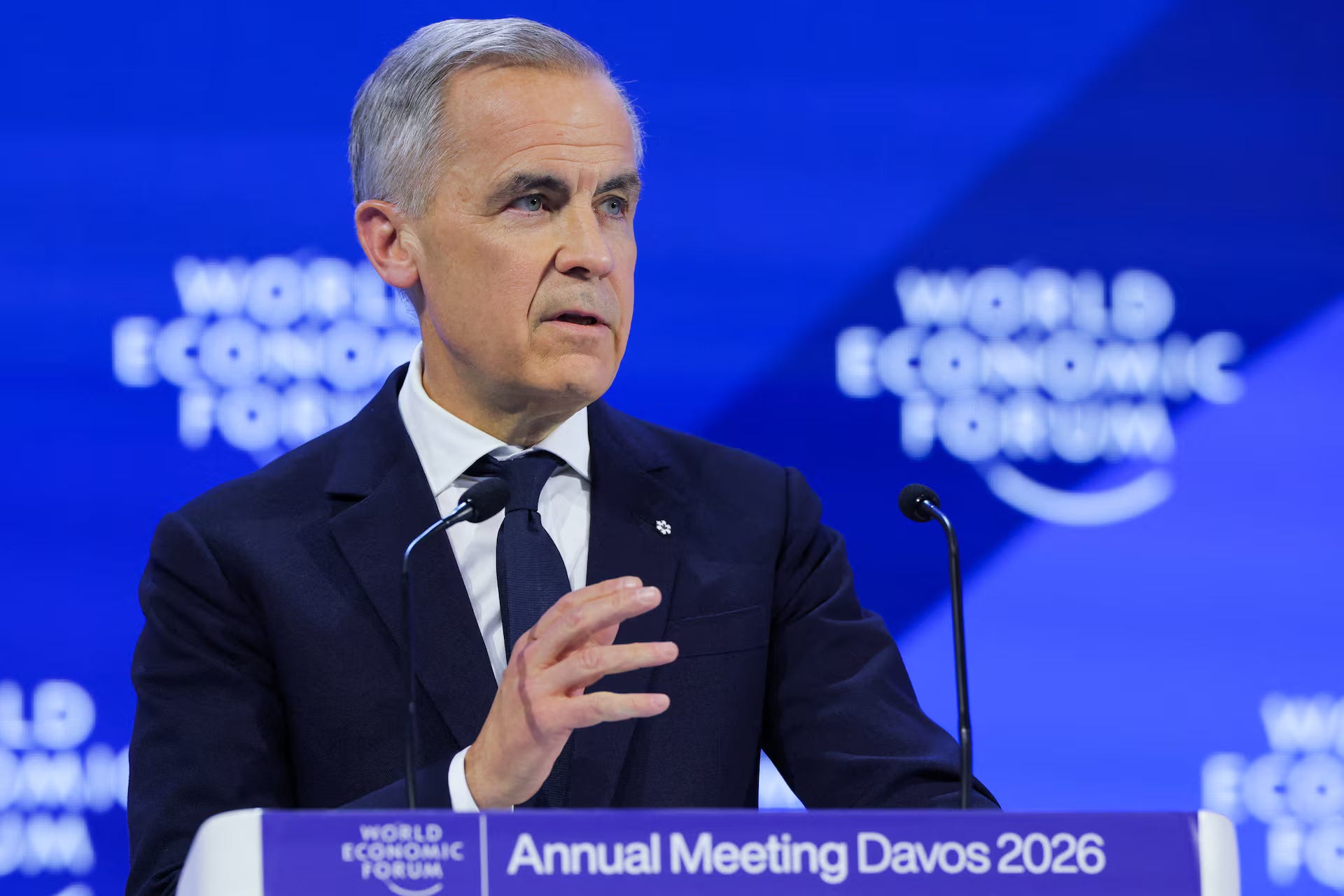
This past week, Canadian Prime Minister Mark Carney delivered what can only be described as a magnificently passive-aggressive speech at Davos. Without naming names (though everyone knew exactly which oversized neighbor he meant), Carney articulated what middle powers whisper privately but rarely declare publicly: “If we are not at the table, we are on the menu.” His prescription? Middle powers should stop waiting for someone else to restore order and instead focus on building strong domestic economies through trade diversification with fellow middle powers rather than complete dependence on great power patrons.
The speech received a standing ovation, which is rare at Davos. Carney’s message felt refreshingly honest in a world increasingly shaped by major powers. Whether it is American influence in the Western Hemisphere, Russian designs on Eastern Europe, or Chinese assertiveness in the South China Sea, the pattern holds.
As much as I admire Carney’s vision for middle power cooperation, the world is sliding toward realpolitik, where power disparities shape outcomes. We are witnessing proxy conflicts from Gaza to Sudan. Economic warfare has become normalized, with the U.S. imposing tariffs reaching 25% on steel and aluminum imports and China retaliating with rare earth export restrictions.
The architects of the post-World War II order imagined that institutions like the United Nations (UN), World Bank, and WTO would manage competition and protect smaller states. Results have been mixed. The UN Security Council has been paralyzed by vetoes—Russia alone has exercised its veto 143 times since 1946. The WTO’s dispute resolution mechanism collapsed in 2019 when the United States blocked appellate body appointments.
One post-war achievement remains: the European Union (EU), nurtured by the Marshall Plan, through which the U.S. poured approximately $13 billion (equivalent to roughly $173 billion today) into European reconstruction between 1948 and 1952. This created interdependence that made war economically irrational. The result has been the “Long Peace”—no great power conflict since 1945, unprecedented when compared to the World Wars that killed approximately 80 million people combined.
Yet the EU also exposes the limitations of middle power cooperation. The 2008 financial crisis revealed deep fractures over Greece’s €323 billion debt. More recently, unity cracked over Russian energy dependence (Germany imported 55% of its gas from Russia pre-invasion), sanctions implementation, and immigration policy (Hungary accepted 1,294 asylum seekers in 2022 while Germany accepted 244,132).
The EU’s struggles remind us of what happens when a stabilizing force weakens. For seven decades, the United States has provided security, maintained freedom of navigation protecting $14 trillion in annual maritime trade, and offered a stable reserve currency. When that central role recedes, underlying tensions resurface.
The unsentimental truth is that the world absolutely needs middle powers for trade, resources, and innovation. Global trade flows of $32 trillion annually depend heavily on middle power participation. But we should maintain clarity about structural realities.
Perhaps the sternest reminder came from how quickly Donald Trump reversed course on Canada’s recent moves with China. In early January, Canada secured an agreement allowing resumed canola oil exports (worth potentially $2 billion annually) while agreeing to import 49,000 Chinese electric vehicles. Initially, Trump praised the pragmatism: “When you get a deal with China, you take it.” But within 72 hours of Carney’s Davos speech, Trump threatened 100% tariffs on Canadian goods with Chinese content.
Here is where we need to take a detour to talk about ferns and trees, a metaphor that captures the structural reality of middle power existence. In a forest, a fern growing under a massive oak does not compete for the same ecological niche—that is a losing game. The oak represents the great power, naturally dominating the canopy and claiming most of the available light. The fern, like a middle power, cannot challenge this fundamental arrangement. Instead, it finds scattered patches of sunlight filtering through the canopy and builds a survival strategy around those opportunities.
The oak is not actively suppressing the fern out of malice—it simply occupies the space that great powers occupy, taking what they need to thrive. The fern survives not by growing upward to compete directly, but by adapting to the shade, finding the gaps, and making the most of limited resources. This is essentially what Carney proposes for middle powers: pragmatic adaptation to existing conditions rather than futile attempts to reshape the forest itself.
Canada’s current trade position is like a fern that has only grown in one direction, leaving it vulnerable if conditions in that single patch of sunlight suddenly change. Canada’s top five non-U.S. export partners combined accounted for just $105 billion compared to $435 billion to the United States alone. Roughly 75% of Canadian exports go to a single customer, a concentration that would terrify any economics professor discussing supply chain risk.
The economic case for diversification is not about political autonomy—it is basic risk management. South Korea expanded its trade partnerships across Southeast Asia and Europe between 2010 and 2023, growing ASEAN trade from $90 billion to $191 billion and EU trade from $79 billion to $142 billion. The result? Reduced vulnerability to any single market downturn while maintaining GDP growth averaging 2.7% annually.
For Canada, the opportunities are tangible: India’s $3.7 trillion economy demands Canadian potash and pulses (lentil exports already exceed $1.7 billion annually); Indonesia’s 277 million consumers and 5.3% growth rate need agricultural products and mining equipment; and Japan’s $11.9 billion in Canadian imports could expand significantly in LNG as they transition away from other suppliers. Meanwhile, Canada’s EU trade reached $119 billion in 2023 under CETA but represents just 1.5% of total EU external trade—substantial room for growth exists as Germany seeks alternatives to Russian energy and France increases plant-based protein imports.
This is where successful middle powers like Australia offer instructive examples. Australia maintains China as its largest trading partner ($202 billion in two-way trade in 2023) despite significant political tensions, while simultaneously strengthening ties with India ($50 billion), Indonesia, and ASEAN nations collectively. This resembles a fern extending fronds in multiple directions to catch scattered sunlight filtering through the canopy, rather than trying to grow straight upward into the oak’s space.
Canada will always exist in proximity to the United States—this is simple geography and economic reality. Carney understands this, which is why his Davos speech never suggested turning away from the primary relationship. Instead, he is advocating for “constrained pragmatism,” working within natural limitations while cautiously exploring their edges.
This pragmatism will serve Canadians well in the medium term, but make no mistake—it will not fundamentally reshape a world order where great powers remain key players. The cafeteria will still have its center tables. The forest will still have its towering oaks determining how much light reaches the understory. Middle powers can survive, even occasionally thrive, by being smart, adaptable, and realistic about their constraints. What they cannot do is rewrite fundamental structural realities.
The fate of the middle power, then, is neither complete dependence nor genuine autonomy, but rather the careful work of navigating between these poles, seeking marginal improvements, building modest coalitions, and finding opportunities in the spaces that remain available.