


Want to know a reliable method for appearing intellectually sophisticated in nearly any social setting? Here is the formula: simply articulate a critique of Donald Trump’s policies, character, or conduct. It has become something of a cultural reflex, criticizing the current president is widely interpreted as a mark of thoughtfulness, regardless of the substance or originality of the criticism itself.
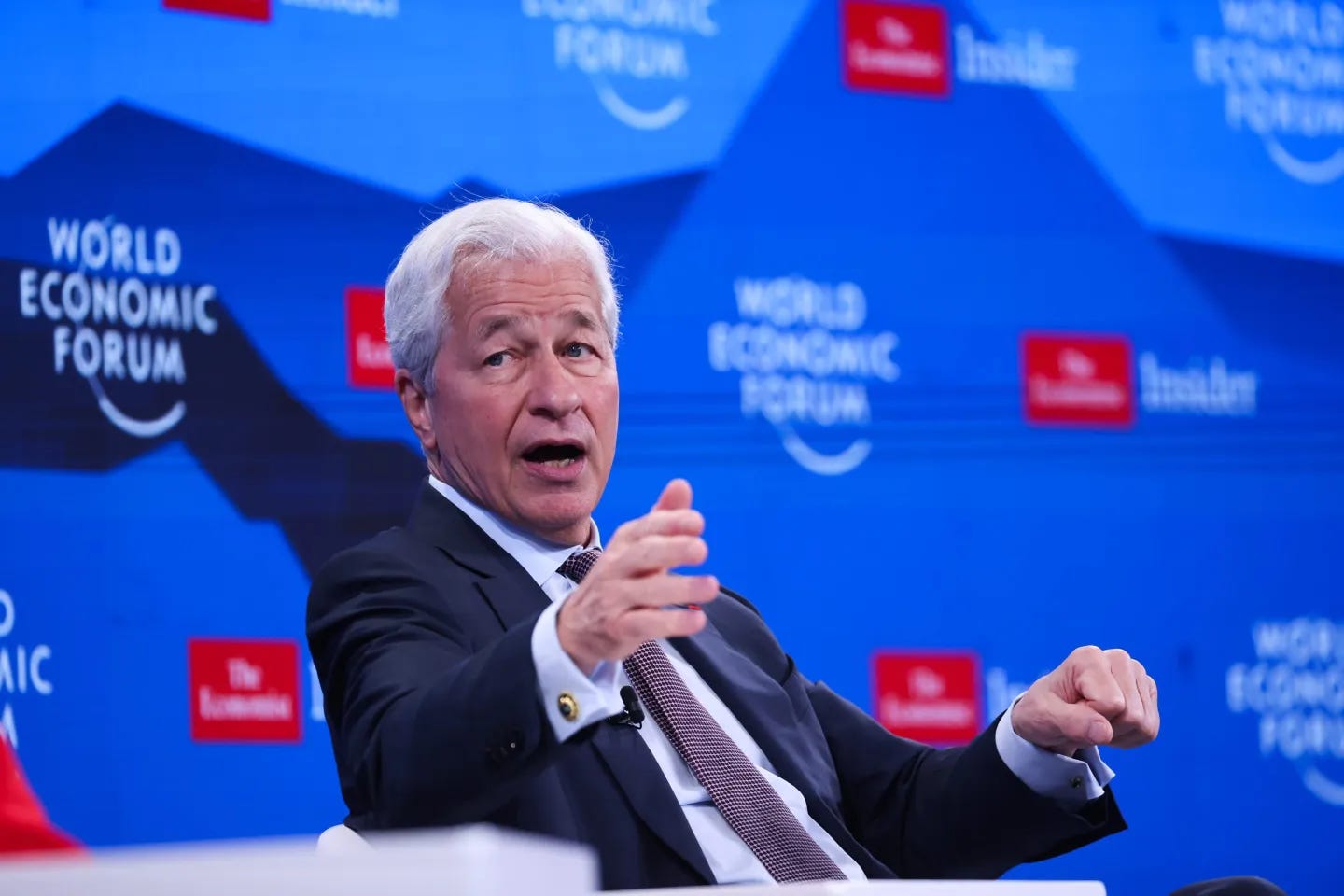
At a recent conference, the editor-in-chief of The Economist Zanny Beddoes spent considerable time grilling JPMorgan Chase CEO Jamie Dimon on the perils of Trump’s policies. She asked directly whether the Trump administration is making the world safer and stronger, and making NATO stronger.
Jamie responded: “I do not think it is a binary thing.”
As Jamie continued explaining how difficult it is to assess policy impacts until years later, Zanny pressed harder, characterizing Trump’s approach as “a transactional foreign policy; a foreign policy that places much less weight on alliances; a bullying foreign policy.”
Bullying whom? American allies in the European Union, partners in Asia, Canada presumably. But is America really bullying, or is it desperately watching the world order it built after World War II crumble and taking a last-ditch effort to save it?
The world order as we know it emerged in the wake of World War II. Almost immediately, the world descended into the Cold War, a battle for supremacy between the United States and the Soviet Union. While the war appeared to be a competition for military dominance, what the two superpowers were really battling over was which economic system would lead the global order.
The Soviet Union was what Mao would call a “paper tiger”—something that appears powerful but is actually ineffectual. By 1989, the United States GDP was approximately 5.6 trillion dollars compared to the Soviet Union’s estimated 2.5 trillion dollars, more than twice as large. The United States heavily fortified Western Europe through the Marshall Plan, which provided over 13 billion dollars to rebuild European economies between 1948 and 1952. The Soviet Union disintegrated in 1991, cementing the preeminence of the American century.
While much of the world’s focus in the 2000s was placed on the United States spreading its influence in the Middle East, a more important development was happening at home: the internet and personal computing revolution. You saw the birth of generational companies during that period: Apple, Amazon, Alphabet, Microsoft, PayPal, Facebook, and Nvidia—now the leader in powering today’s artificial intelligence revolution. While American involvement abroad showed the limits of military intervention, in the digital realm that frontier was infinite.
This pioneering lead made the United States a superpower. Beginning in the 2000s, the United States equity market has averaged a cumulative annual return of approximately 10 to 12 percent compared to around 5 percent for global markets excluding the United States, with performance heavily dominated by technology. This revolution is happening again today with artificial intelligence, as United States GDP has been revised upward. Recent quarters have shown GDP growth around 3 to 4 percent, driven by strong artificial intelligence investment and productivity gains. Elsewhere in the world, economies remain subdued compared to the dynamism and resilience of the American economy.
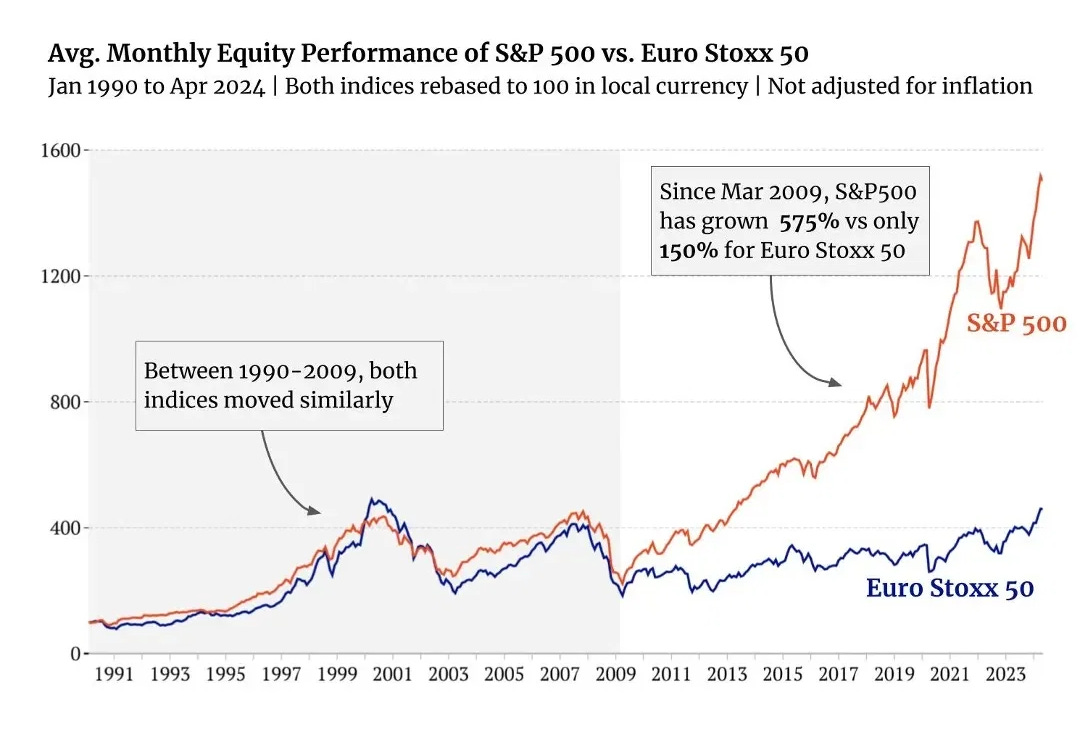
And that is a problem.
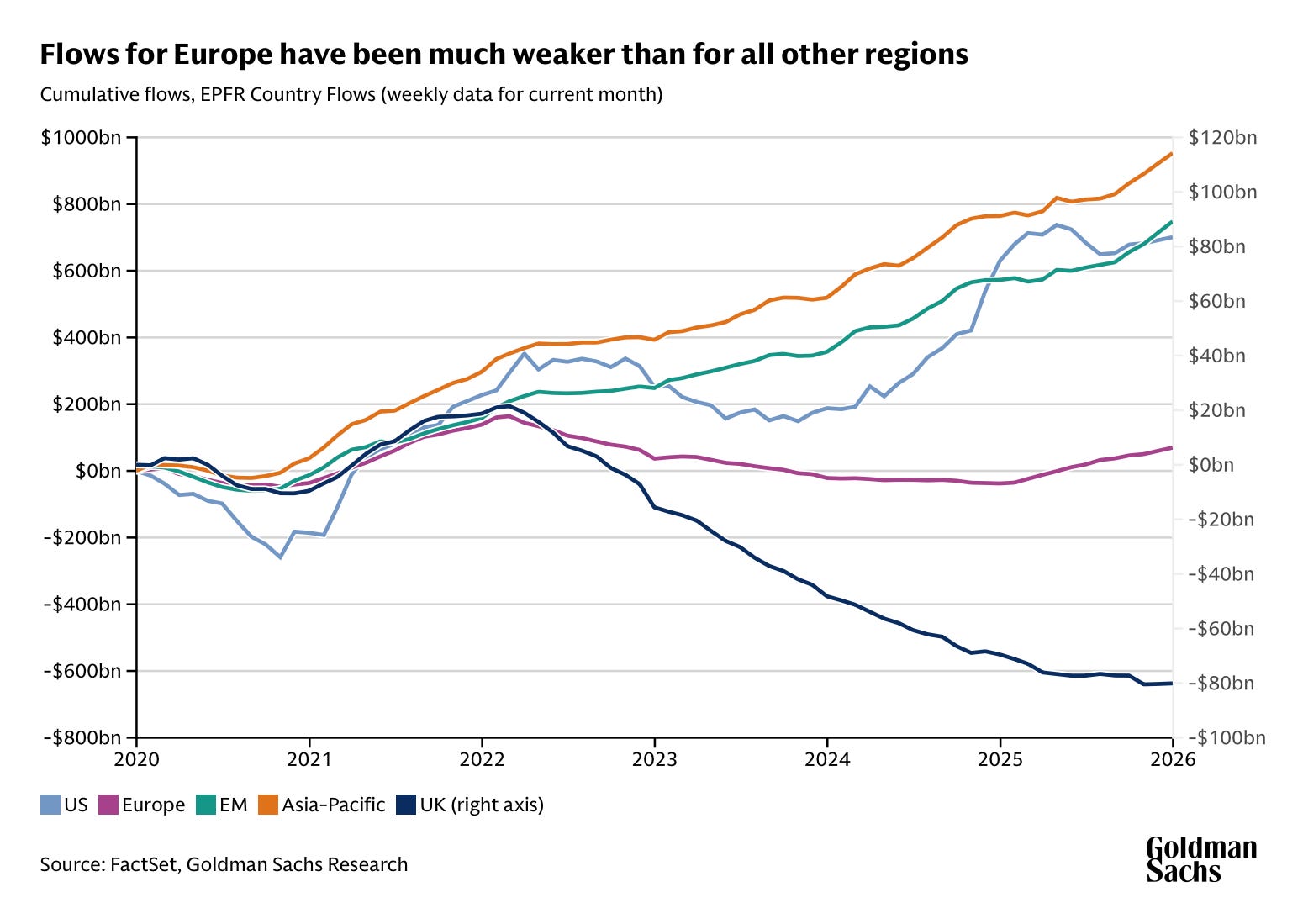
For the free world to thrive, you must have vibrant economies and trade. But the European Union is weakening. As Canadian Prime Minister Mark Carney called it, “we are in the midst of a rupture, not a transition.” Under this so-called rupture, the United States appears to be the villain because it is threatening tariffs and attempting to rebalance trade through economic pressure.
The question to ask is: who is not living up to their end of the bargain?
Carney himself acknowledged that under the liberal international order, the United States “provides public goods—open sea lanes, a stable financial system, collective security, and stable frameworks for resolving disputes.” But all of this is not free and comes at a cost funded with record debt spending.
The United States provided over 122 billion dollars in military, financial, and humanitarian aid to Ukraine through 2025, more than the European Union’s combined contribution. Why is not everyone else chipping in proportionally?
To be fair, many European nations are meeting their NATO commitment of spending 2 percent of GDP on defense. Some, like Poland and the Baltic states, even exceed it significantly. The problem is not that they are shirking their responsibilities by the agreed-upon metrics—it is that the total sum remains insufficient, and more critically, it is not growing at the pace required to match the threats of our time. When your baseline is small and stagnant, meeting a percentage threshold means little in a world where adversaries are expanding their capabilities exponentially.
But the deeper issue is not just about defense spending. Why is not more money being invested in developing domestic industries and technology? Some might argue that America has an advantage because it is a larger, more unified market. This argument crumbles under scrutiny. The European Union represents a market of over 440 million people with a combined GDP comparable to the United States. Size is not the issue. The issue is that European institutions are actively hostile to technology development. Rather than fostering innovation, they strangle it with regulation, bureaucracy, and risk aversion.
Consider the General Data Protection Regulation, the Digital Markets Act, the Digital Services Act, the Artificial Intelligence Act—layer upon layer of regulatory frameworks that create an environment where building the next Google, Amazon, or Nvidia is virtually impossible. European venture capital is a fraction of what flows in the United States, not because Europe lacks capital but because the institutional environment penalizes risk-taking. Start a tech company in San Francisco, and you have access to investors who understand that a few hundred failures might fund one world-changing bet. Try the same in Brussels or Paris, and you will spend more time navigating compliance frameworks than building your product.
In Canada, the story is similar. The country is dependent on financial services and natural resources. But when it comes to the tech sector, Canada has little to boast about. Instead, Canadians poured excess capital into real estate, creating a nationwide housing affordability crisis. When prices stopped rising, real estate became a net drag on growth. Really? Is this what America subsidized Canadian defense for?
As Jamie Dimon noted, America is less stable now than it used to be. It is less stable because its debt is ballooning—exceeding 36 trillion dollars in 2025—and it cannot sustain the same burden knowing that other Western nations, while meeting their formal commitments, lack the economic dynamism to shoulder a proportional share of the free world’s future. Meanwhile, China is eating their lunch as European industries face increasing threats from Chinese innovation and manufacturing prowess. A weaker Europe is a fragmented Europe, and a fragmented Europe is historically a warzone.
Yet somehow, America is cast as the villain, and Trump is labeled insane. This is not to say America has not benefited from these relationships—it has—but America cannot be the sole bearer carrying the free world on its shoulders. The unipolar moment has ended.
I do not always agree with Trump’s method of leveraging tariffs and issuing threats to compel other Western allies to make needed reforms. But let us not forget that America is not the one needing this change, as it always has an ocean to retreat behind, as it did after World War I. What emerged then was World War II. This time, the United States decided to stay engaged, to stabilize Western Europe and reject isolationism, creating the greatest prosperity ever witnessed in human history.
We stand now at one of those rare inflection points in history. The institutions that kept the peace for eighty years are groaning under the weight of outdated assumptions. The bargains struck in the ashes of World War II no longer reflect the distribution of power or the nature of threats we face. We are between two worlds.
And this is precisely where Trump is right. Not in his methods, perhaps, but in his diagnosis: the free world is in decay, and it is not because of America. The survival of the free world cannot rest on American strength alone. It requires a collective commitment—not merely to meeting technical thresholds of defense spending, but to fostering the innovation, economic dynamism, and shared sacrifice that security in the modern age demands.
Freedom is not a gift that, once given, remains forever. It is a condition that must be actively maintained, defended, and renewed by each generation. The free world only remains free when all who benefit from its order contribute to its preservation. Security cannot be outsourced. Prosperity cannot be assumed. Innovation cannot be regulated into existence.
America will survive the unraveling of the current order. The rest of the free world may not. Trump’s rhetoric may be crude, his tactics blunt, but the underlying truth remains: either the West rediscovers its capacity for renewal and shared responsibility, or the ocean that once protected America will isolate it. The free world was never a birthright. It was an achievement—one that must be earned again and again, or it will simply cease to be.