


Walk into any grocery store in Canada right now and you’ll see it: that moment of sticker shock when someone picks up a package of ground beef, glances at the price, winces, and puts it back. Maybe they reach for chicken instead. Maybe pork. Maybe they just leave the meat section entirely.
This isn’t your imagination. Beef prices jumped 16% in a single year and now sit 35% higher than the five-year average. A family barbecue that used to cost $40 now runs closer to $60. That ribeye you grabbed without thinking? It’s become a luxury purchase you have to budget for.
This isn’t a temporary blip that’ll correct itself when “things get back to normal.” This is the new normal. And the reason why reveals something deeply unsettling about how fragile our food system actually is.
The crisis started not in a boardroom or a policy meeting, but in a parched field in Alberta. In the summer of 2024, as Canadians complained about wildfire smoke and record heat, ranchers across Western Canada were making impossible decisions. Their pastures were brown. Their hay costs had doubled, sometimes tripled. By June 2025, two-thirds of Canadian agricultural land was experiencing moderate to extreme drought. In some regions, a bale of hay that normally cost $150 was going for $300.
When you’re a cattle rancher and you can’t afford to feed your herd, you have two choices: go bankrupt, or sell your cows. Most chose to sell. The problem? Those weren’t just any cows. They were breeding cows—the mothers of future calves, the foundation of the entire beef supply chain. Selling them was like dismantling the factory that makes the product.
Biology becomes brutal economics when you realize you can’t just “make more beef” the way you’d ramp up production of smartphones. A cow needs to be born, grow for a year and a half until she’s ready to breed, get pregnant, carry a calf for nine months, and then raise that calf to slaughter weight. From the moment you decide “let’s make more beef” to the moment that beef hits your grocery store, you’re looking at three to four years minimum.
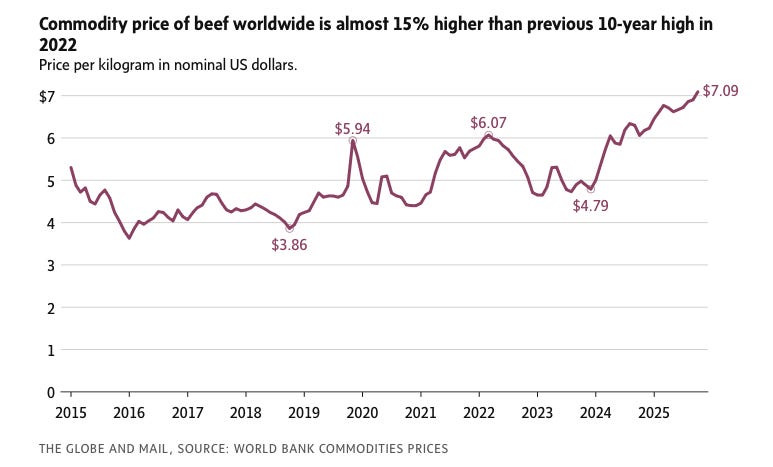
Canada’s national cattle herd is now at its lowest level since the late 1980s. The U.S. herd, which the country is deeply integrated with, is the smallest it’s been since the 1960s. This is about 86.2 million head of cattle in America, down from over 100 million just a decade ago. The factory has been dismantled. And rebuilding it takes time.
Even if ranchers decided tomorrow to start rebuilding their herds, which many can’t afford to do, they’d have to keep female calves for breeding instead of sending them to slaughter. That means less beef on the market in the short term, which keeps prices high even as the industry tries to recover. It’s a cruel paradox: the act of fixing the problem makes the problem worse before it gets better.
Now add this twist. Canada’s beef industry isn’t just dealing with drought and biology, but also a processing system that looks less like a competitive marketplace and more like a monopoly board game where two players own everything.
Two companies, Cargill and JBS, control somewhere between 80 and 90% of Canada’s beef slaughtering and processing capacity. That’s it. Two multinational corporations standing between the rancher and your dinner plate, deciding what gets paid and what gets charged. When you have that kind of market concentration, strange things happen. Cattle prices hit record highs in 2025, which should mean ranchers are doing well. But retail beef prices also hit record highs, which suggests someone in the middle is doing very well indeed.
In the U.S., this dynamic got so egregious that JBS settled a class-action lawsuit for $83.5 million over allegations of price-fixing. In Canada, consumer groups and ranchers alike are calling for investigations, but the Competition Bureau has been slow to act. Meanwhile, grocery retailers, five major chains that control most of the market, have started charging suppliers new fees and penalties, which forces those suppliers to raise wholesale prices just to survive. The result? You’re paying more, but it’s not clear how much of that extra money is actually going to the people raising the cattle.
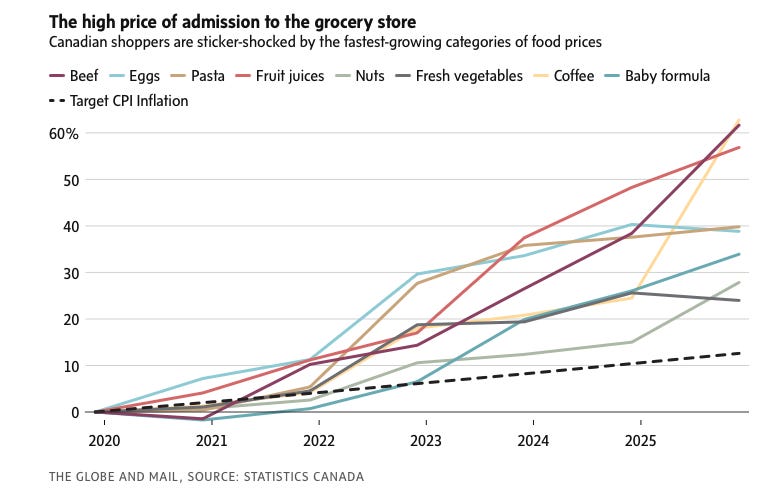
This is where the inflation story gets weird. If you look at Canada’s official inflation rate in late 2025, it was sitting around 2.2%, right where the Bank of Canada wants it. Except when you drill down into what people actually buy every day, the picture changes completely.
Grocery prices rose 4.7% in November 2025. Fresh or frozen beef? Up 17.7%. Coffee? Up nearly 28%. But gasoline was down almost 8%. So if you’re someone who drives a lot and doesn’t eat much, inflation feels fine. But if you’re a family trying to put dinner on the table, it feels like the economy is lying to you. The “perceived inflation” for most households sits around 4%—double the official number.
What does this mean for your household budget? The average Canadian family of four is expected to spend $17,571 on food in 2026, nearly $1,000 more than in 2025. Food prices are now 27% higher than they were just five years ago. One in four Canadian households is now classified as food insecure. In Toronto, one in ten residents is relying on food banks.
The behavioural shifts are obvious if you’re paying attention. People aren’t buying ribeyes anymore, they’re buying ground beef. They’re not buying steaks, they’re buying blade roasts and brisket, the tough cuts that require hours of slow cooking to become tender. They’re switching to pork, which has only gone up 13% since 2022 compared to beef’s 38% increase. They’re buying chicken, except Canada ran out of domestic chicken in 2025 and had to import over 45 million kilos from the U.S. just to keep up with demand.
This is “trading down” in real time. Not because people’s tastes have changed, but because their budgets have forced them to adapt.
The federal government, to its credit, has tried to respond. In early 2026, Carney replaced the old GST Credit with the new “Canada Groceries and Essentials Benefit,” which provides enhanced payments to 12 million low- and modest-income Canadians. A couple with two kids could get up to $1,890 over the year. It’s $11.7 billion in targeted relief, indexed to inflation.
There’s also a $500 million “Strategic Response Fund” to help businesses absorb supply chain shocks without passing costs to consumers, and a $150 million Food Security Fund for small agri-food businesses. These are real measures. But they’re also Band-Aids on a structural wound.
So when does this get better? The short answer: not soon.
The 2026 Food Price Report predicts meat prices will rise another 5 to 7% this year. Cattle prices might ease slightly from their 2025 peaks, but they’ll stay well above the five-year average through 2027. A modest supply improvement might begin in 2027 as herds currently being rebuilt reach maturity, but full herd recovery is a 10- to 12-year process. That’s not a typo. Ten to twelve years.
Even under the best-case scenario—perfect weather, no more trade wars, ranchers aggressively expanding—you’re looking at 2030 before beef prices return to anything resembling “affordable.” And that assumes nothing else goes wrong. Which, given the last few years, seems optimistic.
The beef crisis is a reminder that the food system we’ve taken for granted is far more fragile than we realized. It’s a system vulnerable to drought, corporate consolidation, trade chaos, and the slow, unforgiving biology of cattle reproduction. And once it breaks, it doesn’t snap back. It takes years—sometimes decades—to rebuild.
So the next time you’re standing in the meat aisle, staring at a $35 package of ground beef and wondering what happened, remember: you’re not looking at a price. You’re looking at the cumulative failure of a system that didn’t plan for scarcity, didn’t regulate for competition, and didn’t prepare for a future where the old rules no longer apply.